Writing

Project
2014

OCAD DPXA Artist Residency Talk

1Helvetica; ;;; -3140 Alex Fischer\ OCAD Talk March 11, 2014\ SLIDE\ Versions\ Hello!\ My name is Alex Fischer and I am a visual artist living and working out of Toronto, Canada.\ I was recently invit…

“OCAD DPXA Artist Residency Talk.” 2014.

1Helvetica;
;;;
-3140
Alex Fischer\
OCAD Talk March 11, 2014\
SLIDE\
Versions\
Hello!\
My name is Alex Fischer and I am a visual artist living and working out of Toronto, Canada.\
I was recently invited to do an Atelier at OCAD University as part of their Digital Painting and Expanded Animation program\'85 the workshop was set up for final year students who were putting together their thesis\'92 and it involved a series of critiques and lectures by each visiting artist.\
Uh, I was lucky enough to be one of those artists and for my workshop I put together a lecture on what it is I do and think about as an artist who has practiced and exhibited for a few years with commercial galleries.\ '85\
So yeah, as an introduction I should say that medium-wise I\'92m primarily a digital artist, though I also make prints and some mixed media assemblage type sculpture\'85 I make most of my work by layering and collaging images and materials digitally and then drawing and painting them together with a wacom tablet\'85\ '85Most of my digital images are also done with the intention of being printed and displayed in a space\'85 These are the Limited Edition Prints that I sell to make a living.\ '85I do try and made both the digital and the print versions a relevant part of my practice. So as you can see here,

Refer to slide
I like to customize each aspect\'85 '85from designing the frames\'85 to making a responsive website so that the works will look their best on any surface or screen\'85\ '85I consider myself.. sort of a digital-native since really I
grew up
making digital art\'85 It really wasn\'92t until I went to do my BFA in 2005 that I tried out and took seriously other traditional media like painting and photography '85. And even though those media became integral for how I think about images, I always came back to working digitally.\
SLIDE\
Nowhere To Fall, Following A Lead\
Um, I\'92m not going to show you much of my really early work but here are a couple just to give you an idea\'85\
Here are two digital collages from 2003\'85\
With the limits of the technology I had at the time these were limited to being tiny tiny tiny digital collages. Like 500 pixels square.. only a quarter the size of a instagram photo. Postage stamps now.. but they fit on a CRT monitor nicely a decade ago.
I wanted to start off sort of chronologically because while I don\'92t do talks very often, the decision to come here and speak has had me thinking about how I got to where I am, what I used to make and how and why that\'92s changed in the last few years.\
So ya, in the beginning\'85going to art school was always a certainty for me. I had a talent for drawing and rendering things growing up, family and friends supported me, and I was into new media stuff and kept making THIS sort of work that developed my interest in thinking about abstraction and media specificity and that sort of thing\'85\ '85Now because I did this sort of '93sophisticated\'94 abstract work when I was 16 I also developed AS huuge an ego as any young artists can\'85 aaand I wanted to mention that I used to have an ego\'85 because after a few years of practicing art outside of school it has certainly\'85 waned away a bit.
I think this is worth bringing up as many of you are probably about to graduate\'85. And while it\'92s important to maintain confidence about your art within a community of your peers\'85 The art world is big\'85 and once you\'92re out of school you\'92ll suddenly be vying for the same attention as every other artist out there. '85just because you make good work doesn\'92t mean people are going to pay attention.
Now, I don\'92t mean to get you Down right off the bat\'85 of course there are many different avenue\'92s you can take to have a life as an artist\'85
I\'92m going to talk mostly about what I do today, but I should mention now that\
I\'92ll going to put some links up at the end of this talk to some great resources which provide advice on how to pursue many those avenues\'85\ '85\
ya.. For me anyways\'85 even after selling lots of my thesis work\'85 I found I had to think hard about how I was going to practice and get on in the art world.\ '85Nobody was telling me what I should do, nobody was telling me what was important and so in basically just trying to maintain my authenticity and my career..\
most of what I kept repeating to myself were the sort of art school mantras of '93Keep working\'94; '93Pay more attention\'94; and '93Think again\'97(asking) am I really sure about that?\'94\
SLIDE\
Mantras\
When thinking about how I was going to do this talk I kept trying to think of the most important bits of wisdom that I might be able to share with you guys\'85 and the things that stood out the me most were those sort of mantra\'92s. '93Keep Working, Pay Attention, Think again.\'94\
The first one should be obvious, you have to work hard. Practice as much as you can.\ '85For me that means get up every day and put in the hours: Draw, Paint, experiment with filters and new software\'85 I try to always work more often than I think I have to.. and I sit at my computer more hours than I\'92d like to admit\'85 '96I read articles, magazines, and look through artists books and read theory and criticism all as part of my practice\'85\
It\'92s kind of a lucky profession in that even going to exhibitions and openings is something you can think of as part of your job\'85\ '85 and really looking at what others around you are making is probably a good idea\'85\ '85Then there\'92s the second manta\'85 '91Pay Attention\'92.\
I initially interpreted this as a sentiment that I should '91Pay Attention\'94 to my precursors.\ '85There are and were a whole lot of creative people who have worked through their own issues with art for a long time and just because they were of a different time doesn\'92t discount their achievements. Their efforts are what set the precedent for all the avenues of art today.\
This looking at and paying attention is something sort of leads into the third point\'85 which is\ '93Look again\'94, '93Think again\'94 and ask '93am I really sure?\'94\
It\'92s this checking myself and thinking about thinking that directs my research now. In Psychology the term for thinking about thinking is metacognition. In practice it means trying to understand ones own biases and the context by which we look at the world.
It\'92s been really humbling for me to pursue and think about this since it requires acknowledging that I\'92m working from some form of ignorance. '85I think this is also a relevant thing to bring up because we\'92re all working from ignorance of some respect. '85The idea shouldn\'92t be too dissuasive though\'85 if anything it\'92s equalizing\'85 that all of us, at the same time, are '91winging it\'92 in a sense.
SLIDE\
Harold Rosenberg Quote\
To give you an argument from authority for this theory of practicing within ignorance\'85
I\'92ll give you a quote from Harold Rosenberg who in his book on the de-definition of art recognized that while: '93The function of the university is to impart knowledge, [it\'92s important to remember that] art is not solely knowledge and the problems proposed by knowledge; art is also ignorance and the eager consciousness of the unknown that impels creation. No matter how cultivated someone is, every creator is in some degree a na\'eff, and relies on their particular gift of ignorance.\'94
One way of reading what Rosenberg\'92s saying here is that if we really knew everything, if universities could just feed information to us and we could retain All of it then we might all just be making the same art\'85 and how boring would that be\'85\
I mean\'85some people might even argue that this has happened to some degree (\'85we\'92re all so similar today in that we\'92ve pursued degrees in art and more or less read the same theory\'85)\ '85But luckily retaining everything isn\'92t the way our brains work.\ '85We all get to work from our own
more or less
unique albeit naive perspective.\ '85\
Now\'85 I don\'92t want you to think that I\'92m encouraging you to be naive\'85
Really I think the more important point in that quote is about '93the eager consciousness of the unknown that impels creation\'94\
Recognizing ones ignorance, learning that you were wrong, is the
most
important part of learning\'85 It forces us into thinking about things in new ways.\
But of course.. practicing art within your ignorance could be still seem somewhat disparaging\'85 it\'92s certainly at odds with the artists ego, and It\'92s hard to sell when you\'92re pursuing a BFA or MFA and are supposed to be exhibiting some knowledge and expertise of something\'85
Universities don\'92t escape this quality of ignorance and bias though\'85\
In all sorts of educational institutions there\'92s this paralleled uncertainty today about how to teach students for a future which no one can predict.
Technical proficiency and some historical context sure\'85 but really I think a schools best bet is to provide students the inclination to be curious.
Art school is a safe place to explore and recognize ignorance and then begin to think again in order to determine what you want to actually express and communicate.\
SLIDE\
Seeding Layers\
Now\'85\
For me, with my art\'85 what I\'92ve found is that I quite generally like to communicate recognition of some shared human experience\'85 like many of you I\'92m not content just to feel something. I\'92m compelled to work on things as a means of expression\'85 '85\
In terms of making an image, I often say that I work not From concepts but Toward concepts.\
Sometimes I\'92ll have something specific in mind when I start.. like a scene, or a gesture\'85 but more often than not I just open up a canvas and start throwing things around\'85\
I set out to fail in a way\'85. but I use the techniques that I\'92ve practiced until some concept emerges. Until the shapes I\'92ve put together start to suggest things\'85 '85I\'92m a bit like a painter in this respect in that a composition must emerge from the process\'85\ '85But '97at a point, I become more like a photographer\'85 I capture something that I\'92ve seen.. and then I crop and polish it to engage the ideas that I want to come across\'85\ '85And like I said, the ideas I like to touch on are often heavy with themes of introspection and understanding human experience\'85\ '85In order to reference these themes\'85 I like to draw on the rich history of aesthetics\'85 I include remnants of all types of media\'85 '85and then with the digital canvas I create a melting pot for all these things to come together.\ '85\
Now.\'85It\'92s impossible not to incorporate abstraction through this process\'85\
By mixing things together there is a unavoidable obscuring of media and an obscuring of the meanings and the world that the constituent parts represent. '85I use abstraction as a tool though\'85 it\'92s less explicit, less specific\'85
more interpretable and therefore more universal in its ambiguity\'85\
SLIDE\
Vasily Kandinsky Panel for Edwin R. Campbell No. 4, 1914\
This aiming for abstract '91universality\'92 is already sort of and an old romantic idea that artists have been playing with for a long time.
To bring in a little art history now, I want to talk about this Kandinsky that was at the AGOs '91Great Upheaval\'94 show that just closed\'85 '85 Kandinsky, already 100 years ago, spoke about the universality of images and the reduction of reality in all artistic representations of the world. He painted with the impression of all images being just combinations of different colours and shapes\'85 And he understood that while the world that a painting represents may disappear, that painting can still act as a school for the spectator\'85 that the observers open interpretation of abstraction, colours and shapes and artistic variation can make an image more universal\'85 and more approachable.\ '85I think this is why abstraction has taken off in the last hundred years.\ '85It promises to be timeless.\
SLIDE\
Malevich, Black Square, 1923\
Truly abstraction has become a common tool for artists since it reached it\'92s peak with the neu-avant-garde and their wholly universal images of extreme minimalism\'85 as seen here in Malevich\'92s '91Black Square\'92 of 1923.\

Refer to slide\ '85 This painting was meant to transcend the subjectivities of any particular era\'85\
But as a side-note:
I do find it a little funny that while digital art still has a stigma surrounding its temporality or impermanence\'85\
SLIDE\
Malevich, Black Square (Recent Photo)\ '85some of these paintings intended to be universal and timeless are showing their own impermanence\'85 as you can see here by how '91Black Square\'92 looks today.\ '85\ '85\
SLIDE\
Travess Smalley, Computer Graphic on Vinyl (5), 2013\
Jon Rafman, Auerbach Train, 2013\ '85\
To bring things into the present\'85 I\'92d like to show you how some digital image makers today are using abstraction.\ '85Like with these works by Travess Smalley and Jon Rafman.\
Smalley and Rafman often provide beautiful psychedelic views of our contemporary landscape. They utilize the public understanding of digital motifs and make works that are firmly self-conscious of when they fit into art history. They are very much of the now\'85\ '85\ '85 The trend with post-modernism in general is to deliberately mix different artistic styles and media, and exhibit a self-conscious use of earlier styles and conventions.\
With post-modern
digital
artist then\'85 there\'92s plenty to pick from since digital images can so easily reference the qualities of many different traditional media\'85\ '85Scanned photographs, paintings, generative textures, and 3D models are all one in the same when saved as a jpeg. '85This to me makes the digital canvas seem like a
most
natural melting pot for post-modern image making\'85\ '85It\'92s worth mentioning briefly when talking about post-modernism and deliberateness\'85 that while many types of artists actually work with digital images\'85 it\'92s not until there\'92s this
intentional
blending of media on the digital canvas that an artist usually considers themselves a digital artist.\
SLIDE\
Shane Hope, map_auto_expand_sym (detail), 2011\
Rafa\'ebl Rozendaal, Into Time 13-08-14, 2013.
Now\'85 I do find it a little funny showing a slideshow of digital artwork\'85 since it\'92s kind of like Im just going through my tumblr with you\'85
I do want to quickly show you a few more though..\
and I should let you know\'85 um, if you see something you want to check out later\'85 this whole slideshow is actually a website and the url will also be included at the end so you can find it later\'85\ '85\
To continue\'85 '85Really Uh\'85 I\'92m not going to explain or talk about stuff like net-art, gifs, or video\'85

2013

Faint Magazine Interview

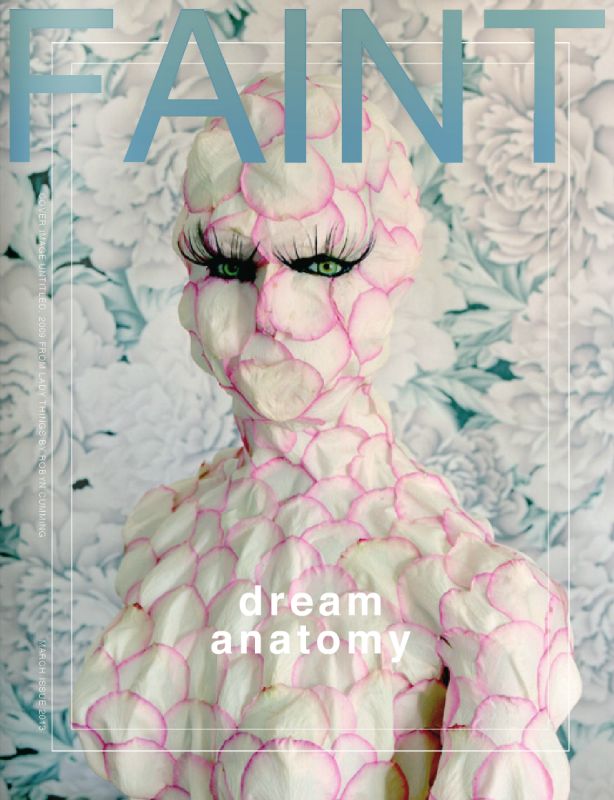
Faint Magazine

‘Adobe Mask, 2012 FAINT MAGAZINE the arto ALEX FISCHER Words and Interview Harley You The visually compelling artworks of contemporary Canadian artist Alex Fischer are a complex view of modern life in…

“Faint Magazine Interview.” Faint Magazine, 2013.

‘Adobe Mask, 2012

FAINT MAGAZINE

the arto
ALEX FISCHER

Words and Interview Harley You

The visually compelling artworks of contemporary Canadian artist Alex Fischer are a complex view
of modern life in the age of information technology and social media. Using elaborate digital tech-
niques to render portraits, landscapes and other abstracted forms, Fischer explores themes related
to online identities, the diversity of broadcast information and the development of subcultures on the
internet. In an ever changing, developing world of new digital forums and “likes”, Fischer presents
images that speak more broadly to the human spirit and ascend the media that was used to create them.

Harley Young: Your back catalogue of artworks appears to be
quite varied in terms of medium, from paintings and seul
ture to your current digital co Can you please
Usa little about your techniques and If you have any prefer-
ences?

‘Alex Fischer: 've always been interested in using what was at
hhand, and with computers boing so ubiquitous in ito, today it
‘seems the cigital is most natural place for me to make artwork. |
still ike to combine the techniques of several traditional media in
rm sculptural work, but as far lat work goes the gta feels like
the most rich environment for me to explore | collect things like
Images and interesting materials and then through either digital
or physical methods le them together. Photoshop is my
workhorse, i's where | sketch out, layer, and complate most of my
work. Even the sculptures Im working on today ar often digitally
sketched out oF 30 modeled before they'e constructed or ordered,
‘That mixing of diferent media is really one ofthe few general con-
stants across in my practic.

Some of your Images evoke Intrigue with their visual
‘Are these portraits based on people known
do

[AF: Woll, | think portraits stil mako up a relevant pat of culture.
Social media portraits are prolific. Many people put a great deal
of themselves into their digital identities. t seems inevitable that

social behavior and sonse of soll. Aciital assemblage then sooms
‘most apt for representing the phenomena of being in a digital
‘environment. | ty to ereate something or someone new through
the layering of many images of faces. In the end I think one my
Portraits may be well understood as an image of many people at
‘once, al with their metaphysical baggage on display.

HY: From looking at photographs of some of your past exhibi-
tion installations it appears that you explore a variety of im-

variations of the same work or theme when they exhibit. Do
you preter not to be limited by conforming to one overall con-
sistency in an exhibition or do the works stand alone not as

they are shown on blogs or gallery walls | feet
liberated knowing that the works will havea lie independent of
‘each other. I come up with work with that independence in mind
and treat each as having a unique character. Though changing
imy style may seem to be @ bit counterintulive for establishing
1 recognizable oouvre as an artist it makes sense to me to use,
combine, and re-imagine the styles at my disposal

‘Also, because the digtal has no natural characteristics the

and scale of a work can vary alot. Ike to practice such @
versatlity of style as moans to represent the variety of visual
languages being broadcast and blogged everyday. | also tend to
sult elyle to scale, If ve set out fo do an image on the scale of

DREAM ANATOMY

‘great history painting it makes sense to use that scale to do a
digital simulation of brush oF paint. Smaller works are prone to
have @ more photographic aesthetic, and some smaller stil may
only exist as a soreen based work

HY: Ate your landscapes taken from the Canadian country-
side of are these constructed environments drawn from the
Imagination?

[AF: | grow up inthe countryside outside of Toronto so I definitely
hhave that influence but they are normally not of any place in pa:

HY: It has beon sald that you explore themes relating to
technology and the internet and how this has influenced
‘modern human beings. Can you please elaborate on this or
toll us alittle about your main inspirations and themes?

[AF: Fielly, | think one of the most interesting things spawning
from the internet today is the concept of cyberbalkanization
Basically, i's the concept that people wil search out and
Culivate similar intrest groups tothe exclusion of thers. I's con
trary tothe traditional idea ofthe internet facilitating globalization
‘and public discourse. Those things undoubtedly happen, but i's
‘eany to forget that Instagram will only show you who you've sub
scribed to, The nature of the web means i's unlikely you'l exist
within a completely closed circle, but the effect has been to sup
port and accentuate an ever-broadening array of subcultures,

More generally my themes relating to technology stem trom an
‘aim to represent the time in which | ve I's easy to 6 the world
today as being heavily influenced by our symbiosis with
technology. However, I ke to have the entre history of media
Inform my practice and so | also take up a historical approach to
Understanding context. The emphasis we put on contemporane
ity tel is a prety recent trond. In big history we've come a tong
way very quickly, and looking to the future, f Moore's Law stays
true we must expect that people will continue to have to adapt to
huge technological advances. These advances are not necessary
noticeable game changers but are much more likely to be
Introduced day by day tous as erations and updates,

There isa sense that we are tumbling forward hastily in in a works
0 rapidly changing. Truly, in 2005 no one could have predicted
that to "Like" something would hold web-culture-lout. Today's
Vocabulary had just not been invented yet. Similarly cultural
language from 2008 now already seems datod. Instagram, Vine,
‘Tumble; these are just the latest. This shit of language will
continue to happen as it has, but now it is augmented ang
hhyper-accentuated by the torrents of digital subculture and social
‘madi. | think as an artist ty to Brush aside the languages that |
think wont have cultural resonance 10, 20, o 100 years trom now.
['mrepresentin the human beings | know in their man-made scene
both for pple today and those who willook back on what we were.

HY: While some of your digital work looks somewhat mini-
‘alist, many others are complex layers of photography and

very painterly information. Are these works created solely by

FAINT MAGAZINE

‘computer manipulation or Is any paint used at any stage in
the process?

AF: These days my flat work Is made entirely through digital
techniques. Sometimes Il scan a particular texture or photo
‘graph something for reference but the assemblage is all done in
Photoshop and Corel Painter. ve done experiments but never
really thought that applying paint or traditional collage to a printed
‘work added al that much I'm more interested in simulating those
traditional texture in order to suggest that the digital versions can
be just as authentic as the printed work

HY: Your sculptural works both compliment and enhance the
two dimensional representations you also create, and yet the
techniques used to make the works are very diferent. Do you
find It challenging to assemble objects in free standing form
that appear as i they have walked straight out of one of your
digital works on the wall?

[AF: I's definitely a challonge | welcome. The tools and materials
‘are obviously quite sifeent but there are stil the same under:
lying principles of authorship being applied. Both the sculptures
land fat works involve a blending of memory, observation, crt
ism, reasoning, imagination, and reconstruction. {find ther isn't
‘a5 much of a difference as people might think between throwing
layers around in a digital space and a physical one. | also think
that a6 3D printing technologies and augmented realty become
more accessible that It's good practice as an artist to hone skills,
for creating both the illsion of space and actual physical ob
jects. The diferance between the two is likely to get les and less
distinguishable

HY: Your work Is represented in distinguished corporate
{and private collections, you have exhibited regularly and are
represented by prestigious O’Born Contemporary gallery in
Toronto, Would you attribute your artistic success at your
young age to anything in particular or offer any advice to as-
piring young artists?

|AF: Make connections and utilze them. While in art schoo! |
applied for as many grants as | could in order to advertise
my thesis exhibition to the Toronto arts community. t was a
Combination of sel-promation and becoming familar with the
gallerists and artists in my local scene that let me know where |
wanted to be and who would be interested in showing my work
I's important to keep some network of peers too; people who
‘are happy promoting each others’ work and who can also offer
‘some ertical discourse. Networking isan inherent part of any arts
‘education today but realy is integral for Keeping up a practic.

HY: Your first published artists book Smarter Today was
published by O'Born Contemporary and Wassenaar in 2010.
Can you tell us alittle of what itis about and do you have any
‘current plans for future publications?

AF: Speaking about seltpromotion.. AS | approached my frst
major solo exhibition | was interested in translating my dig
tal works into take-home editions. A book is usualy a great

DREAM ANATOMY

Introduction to an artists work and is affordable for a collector on
‘any budget. | was fortunate enough to have made a connection
with Wassenaar publishing and so It seemed apt to produce a
limited edtion publication basically intoducing myself with a
Catalog of early works. It aso offered up a writen interview and
scription of my artistic process, which is stil a primary taking
point when someone sees my work forthe fist time

| think a8 nice as it is to hold a book in hand my next project
will ave to be digital. Maybe an iPad style feature that offers
‘some video of detal shots. Im always working onthe design ang
function of my websites too, which I tend to think of as sort of fluid
publications

FAINT MAGAZINE

Opposite Page Grandtather Wreath, 2010
‘This Page Untitled Body Landscape (Part 1), 2007

any artists who have inspired or influenced you in
there some favourites you would recommend

In the past Daniel Richter, Nigel Cooke, and Peter Doig inspired a
lot of my flat work. These days some of my favourites are Enrico
David, Mai-Thu Perce, Matthew Ronay, and Tom Friedman.

artotalxtischer.com

DREAM ANATOMY
2012

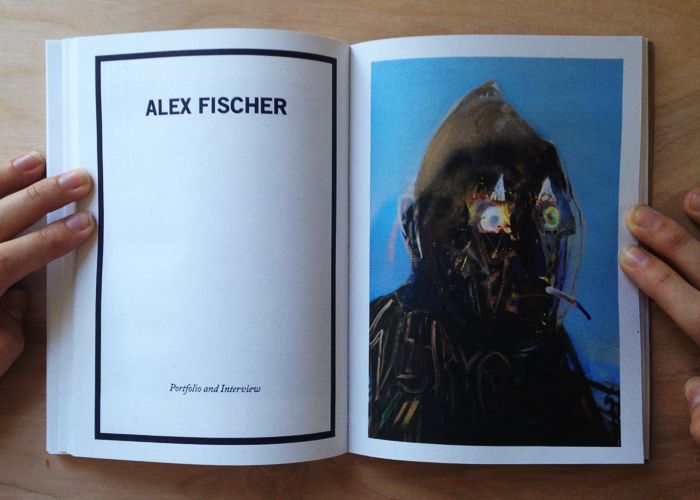
Mossless, Issue 2

Mossless

“Mossless, Issue 2.” Mossless, 2012.

I admire your approach, all from your style to your decision to include pixel dimensions before the inch. Let me begin by asking about your work, however: are your portraits that of people or of society?

I’ve always preferred pixel dimensions. But, I did recently wonder if I should switch to metric standard instead of imperial. The art world is still accustomed to inches though, and 5’ x 7’ does looks sharper than 1.52m x 2.14m. I’m going to skirt a straight-forward answer and say that when I do a portrait I keep in mind that people of contemporary society don’t exist in a vacuum. We’re all connected and influencing each other: society informs us and we inform society. And, the rate at which we’re communicating is increasing thanks to the internet. It is the largest society to have ever existed and embracing it, as many people are, means adjusting the way we think. We’re another step removed from reality, maybe in a state of pure simulation according to Baudrillard, but its effects on how we live and how we represent ourselves are no less real in our experience. So in my portraits I want to show the affect a sort of internet-culturing might have on a person.

Would you then say that social medias increase or reduce our human-ness?

Well, I think humanness is a pretty flexible word because what it’s describing has changed so much over time. If someone in the 15th Century could have looked at any modern person with modern beliefs they would have immediately labeled them as a witch, as inhuman. And, social behaviour has evolved in a variety of species so even sophisticated social interactions are not a great argument for what makes up our humanness. I think an empirical characteristic of humanness has been our ability to increase the rate of our adaptation en masse. Today that ability to adapt is being facilitated by social media; which disseminates ideas faster and more throughly than even email or forums did 10 years ago. Any organizational effort or anything of interest can be assimilated into culture at speed. In that definition social media is increasing our humanness. My only problem with leaving it at that is we leave many other definitions of humanity behind. The world of 2012 still has only 1/3 of all people connected to the internet. Either it will an increasingly flexible and inclusionary term, or we’ll have to come up with a new word.

Your work refers to this thinking, does it not?

It does. As an artist one of my adopted values is to try and be responsive to and represent the time in which we live.

Tell me something about how you see the time in which we live.

I think one of the best ways to understand the Now is to try and understand where we come from and where we’re going-- not to predict the future, but just to understand that there are certain historical patterns that we can recognize. We’ve changed a lot in the last few hundred years and are dangerously still coming to terms with what the 21st Century’s definition of humanity is. Unlike our ancestors we’re creating new environments, increasing lifespans, and lately engaging in mass communication. These technological breakthroughs are so appealing to people that the entire planet is now a melting pot. It’s reasonable to expect that many of the societies and cultures that have been slow to change for thousands of years will have their next generation stirred into the soup that is global culture. Powwows and rallies in town squares used to drive societal change; but modern revolutions are being sped up by social networking and it’s beginning to be an enormously successful way to organize ideas. There are also slower burning, more profound implications: one being that we are now a species unwittingly changing our own nature. 20th Century Modernism established culture as our new nature, but our contemporary situation must accept current culture as a transient affect. Anyone reading this is likely to experience dramatic change during their life. Before the technology existed, there was no way that we could have predicted the multitude of new ways that people would develop their identities. Most young people today find it necessary to be technologically adapt, it’s almost a symbiotic relationship, a second skin and a second life in some cases. We’re heading into a strange new world where we quickly disseminate information and adapt to it. At this point I’m used to the semiotics of language changing before my eyes and as an artist I have to keep on top of that and react to it.

I’d like to get into your work. Could you talk about Bluenose? Is there text on his collar?

Yeah, I meant for it to at least ambiguously resemble some text. I think it’s possible to read Bluenose as ’we have to’ in the sense of feeling we naturally have some sort of obsession. In this case there’s an obsession with looking. And we’re the ones looking. With Bluenose you only get a few symbolic gestures to hopefully spark your brain to wondering what that text and the piece might say. Maybe for some people… those patient to look long enough, Bluenose ends up mirroring the earnest bewilderment that sometimes happens after the act of all that obsessive looking.

What do you look at obsessively, more than others do?

Well, I look at a lot of art and in a culture of data-mining I tend to look for patterns. For me patterns are a bit like reiteration, and recognizing them can be like forming an index to the different preoccupations people have. Looking for those patterns is my current obsession. Physically however what I’m looking at obsessively is the Internet. The screen is where I work, so keeping up with the latest in the arts is a natural accompaniment. There’s an enormous breadth of art to interpret and learn from; I’m of the opinion that the more of it I can immerse myself in the better. Lucky for me a lot of today’s art is fast art.

Alex Fischer: Adaptations

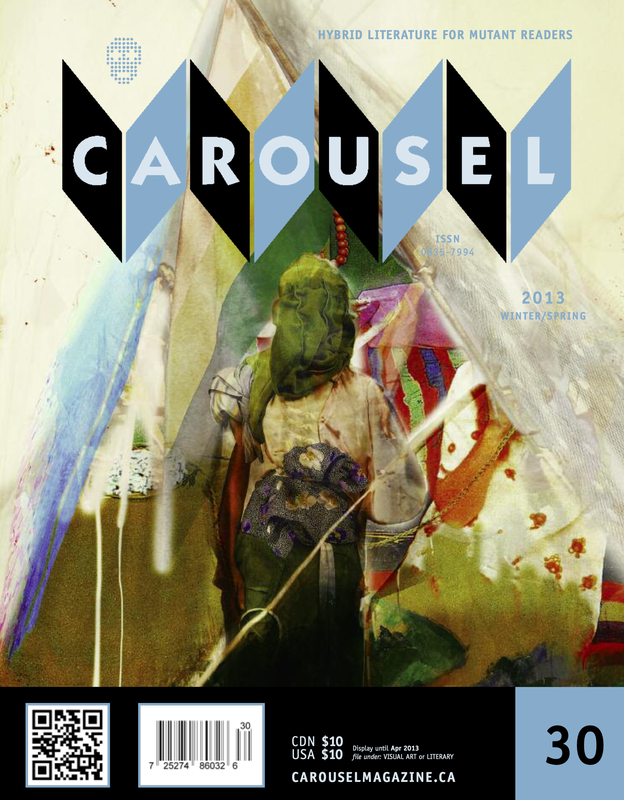
Carousel Magazine, Issue 30

Rachel Anne Farquharson. “Alex Fischer: Adaptations.” Carousel Magazine, Issue 30, 2012.

"The more our world is rendered forth in visual images, the more things are left unexpressed"-Laura U Marks

1. The first line of your artist statement for Beyond the Fall, your second and most recent solo show at O’Born Contemporary, suggests that you aim to represent one of several facts about the time in which we live: the prominent influence of the internet on daily inter and intra-personal behaviours. You deem personal computers with internet capabilities to be the prevailing first-world interface through which we not only receive information, but also mitigate our belief systems and cognitive perceptions. Can you describe in more detail your conception of zeitgeist and why you feel it is an artist’s responsibility to deliver it to their audience through artistic media? To me the conception of zeitgeist shouldn’t exceed an empiricistic understanding. The spirit of our time is something we can measure… Computer sales are through the roof. Cellphones mean we have information at our fingertips. I think media itself is a spirit/zeitgeist of our time. Media is steadily permeating the lives of most people today. Images were made yet more predominant in our lives when we all sat down to look at screens everyday. I think I fall inline with the artistic tradition of of using what is available to me, in my case it made sense for me to use the near infinite sketchpad of photoshop. Artists are granted luxury of being everyday philosophers without having to exist in academia or other bureaucracies I see is as a personal responsibility to reflect the world back on itself.

2. To me, your work seems to embody the cultural dissatisfaction apparent today with the limits of visuality. We want to be able to "see" more, and not only through the avenue of optical consciousness. Is this a factor in your thought process? Yes, well we enjoy it. Our brains evolved to look at nature, now we live in concrete jungles and simulate what we don’t have: stimulation. I think the increased rate of change that contemporary people have experienced is causing them to expect more visuality, that the clarity and vividness of simulation will just keep getting better as it has so far in their life. Art has always belonged to this tradition as well, it just has a lot of extra stuff that can be attached to it as well because of how incredibly broad and focused the visual vocabulary can be.

3. Your work has persistently resonated with the tradition of painting, despite the hyper-contemporary content you are most interested in problematizing (digitally reproduced media). Can you explain the tension embodied by your work between tactile, painterly aesthetic and the slippery quality intrinsic to digital modes of production? I think of it sometimes as ’A Rich History’ versus ’A Digital Flood’. I have attempted to make a lot of my work under the practice of being as broad and richly ambiguous as possible. To me that allowed me to do a few things… things like do a lot of landscapes and portraits. We see them so frequently they’re easily digestible for anyone who’s looking at art. I want people to look, to draw them in. Once they look the content and technique have to do the work of contrasting their preconceptions. It is easy to argue that now most of the images that many people will see in their lives will be on a screen. I think of the creeping in of digital embellishment as a mainstay in artistic production. Many artists today produce, learn, if not communicate through digital means. So there is a back and forth between the historical and contemporary modes of working. Lili once remarked that there is a lot of nature in my work. I told her I thought I was sort of fighting back for nature. Art is so far removed from the common characteristics of Nature that it seems impossible to draw too many references to Nature in art.

4. Laura U Marks reinvigorated the art world’s interest in the concept of "haptics" as it relates to digital media in the earliest part of the current century. The theorist defines haptic perception as the ’combination of tactile, kinesthetic, and proprioceptive functions, the way we experience touch both on the surface of and inside our bodies’. A paradox is witnessed in your digitally rendered images wherein, though they indeed belie the slipperiness of ’cool’ media, the eyes of the viewer begin to function like organs of touch, generating a physiological and phenomenological reaction to the abstracted images perceived. Is this super-conscious experience a recreation of the virtual yet dense relationships and understandings we form through today’s technologically-based interactions? That sounds spot on. The people who use social media are willingly doing it, their eyes are good at picking out detail in front of their face. They’re good at looking because they do it a lot and feel good about it as they do it. Art can provide a very good means for gathering people’s visual attention and using that attention to challenge their assumptions. Many of us are experiencing this shift at more of less the same time and I think it stimulates a reexamination of our relationships.

5. With the exception of "Bow" and "Daily", your colour palette has become far brighter. The hues you have selected for this body of work are often succulent and saturated in a way that assaults the viewer’s overall senses. "Untitled Gaze", for example, presents a near skeletal visage highlighted with bright sanguine-hued components that give the subject a grotesque, flayed-like appearance. Is this shift purposeful or unconscious? In the instance of "Untitled Gaze", are your tonal choices meant to magnify the gorey, Frankenstinian agglomeration of the subject—perhaps as a metaphor for the way in which human personalities and daily experiences are cobbled together from re-appropriated matter today? "Untitled Gaze" was made in a spontaneous way, but when I started to see those references emerging I went with them. So I think they can be a metaphor. We are the product of our environments and my work is a product of it’s assemblage. It’s hard to describe the motivations for a moving interest in colour. To me colour has always seemed low on the public attention scale but high on their periphery. People notice grey palettes but consider them unremarkable. My earlier palette was informed mostly by the paint-like muddiness of mixing too many layers in photoshop. I had to make a deliberate push to colour my work.

6. Despite what can be perceived as an overall shift in palette, works like "Purple Jesus" promote variations in image quality, color, tonal variation, and even tactility in the space between the source and the viewer, creating a heightened subjective experience. You have intimated that the recombination of reproduced media (via collage) enables you to abstract the forms that emerge from your images, submitting your audience to a multitude of interpretations. Why is it important, within the context of your goals as an artist, to leave the work so open and malleable? If my art has to cause some conflict in a person I believe it should first seduce them. When I think of ’a person’ looking at my work I try to think of ’any person’. The sort of endless variety who will bring their own interesting interpretations. I think the ambiguity of the imagery and symbols end up sparking the way brains recall visual information. We’re likely to try and find something recognizable in something that’s abstract. We hallucinate patterns to a degree. We’ll stretch our imagination to try and realize what we see and in the process allot all sorts of associations on a thing.

7. Thinking back to the first time we worked together during a 2010 project for ArtBarrage.com, I remember discussing a work called "Artist’s Retreat" in which the themes of identity and human insularity were very prominent. I had asked you whether you felt that artists are burdened with perpetual loneliness because of their craft, at least insofar as they become isolated within their own thoughts or mechanisms of expression. In your most recent cycle of works, a piece entitled "Artists Image" bears an important resemblance, thematically and conceptually, to "Artist’s Retreat", suggesting that the notion of solitude within the context of artistic pursuits remains unresolved. Here again, the figure is presented in a hazy and barren landscape, though not relegated to a small land mass or island as in "Artist’s Retreat". In "Artists Image", it almost looks as though the figure has finally made it to shore, the breaking crests of waves advancing in the background. The digital "noise" that obscures the image makes the figure look like an apparition and cracks in the surface plane at the bottom of the work resemble both damaged photographic emulsion and plant matter sprouting from the inanimate material of piece. Could the insularity you continue to explore also relate to the inevitably private experience of using social media and computational devices? I’m going to first mention that "Artists Image" is quite a small piece. I wanted something so blatantly serving as a self portrait to be a small contribution to my body of work. The reading of that might most easily come from the relative size of the printed work. But at the same time I want acknowledge that I am present in the work. It’s a tug-of-war for me between the private experience and "the modern person" being a connected and informed person. There’s another way to think about this private experience and that is that a part of our thinking process is now outside of our mind and bodies. Journals and sketchbooks served as mnemonic devices and now they can exist in public. A facebook wall or blog can record experiences to be looked at again later. Insularity could also be considered a spirit of our age. Though when all that supports that argument is the age old saying "out of sight is out of mind", I think the permeating flow of information on the internet might be some sort of salvation from Insularity. What we think of as private experience today is something that still creates data and drives markets.

8. Tell me a bit about "Aurora", which seems to picture the intersection of the ultimate natural phenomenon and humankind’s current virtual lifestyle. The sky resembles a reverse screen projection upon which an anthropomorphic face is cast. Beneath the veil of the grid-like light pattern, a humble dwelling of sorts is apparent. A final contrast dribbles out towards the viewer as an electric blue river. Do you feel as though people in the most remote areas of the world—for example, the north—govern their lives in a similar fashion to the urban dwellers you aim to represent ? I think ’remote’ doesn’t mean the same thing it used to. I think the places that have more recently lost their remoteness have an interesting spot on the web in as far as there being a previously unknown cultural subset made public. My own narrative on this piece is futurological, a hologram environment by those people who have never see the real northern lights. Melting-pot versus increasing the number of subjective experiences.

9. How does your process differ between the creation of "Wallpapers" and "Art Works"? You have taken the pains to reconfigure your wall papers to different computer display’s aspect ratios. Have you considered how these ratios relate to or approximate human vision? What about contrast ratios (light/areas of darkness, humans can detect 300:1)? Aesthetically they’re mostly about trying to give a texture to phenomenologically derived concepts. "Digital Cells" "Underlying structures" "Pushing the digital envelope" They also have a directed purpose, that being something not too full and easy enough on the eyes to have as a backdrop to other things. They’re relaxing, they can embrace modernist principles and romantic ideals. I’m also focusing more on the translation of digital to physical, so these will serve as iterations of a material wallpaper I hope to include in future exhibitions. Re: Vinyl wallpapers.

10. Returning briefly to a discussion of traditional painted forms, for "The Infant and the Garden Hose", you chose a circular canvas, reminiscent of the tondo of Renaissance lore. This self-contained form, most notably enclosing man as a symmetrical and perfect being, defies the "picture window" of the typical rectangular painted composition and instead asserts itself as both subject and container of subject. You seem to have an understanding of how to harness the tondo’s power, first by placing the horizon line two thirds of the way up the composition and then balancing the yellow-to-blue spectrum of the sky which a brash crimson flag. What was behind your choices for this work? I knew I wanted to use a circular canvas. Computer’s might make it easier to make a circular canvas, but it’s still goes against the default layout of a digital image being a precise number of pixels. (the smallest possible canvas on a computer is one pixel, it takes quite a few before it can resemble a circle.) the main reason I wanted to make a tondo was to take advantage of its effect as a container of the subject. The rectangle is too easily taken for granted. Even though the image has a stretching landscape I wanted give the sense of it being a trap in and of itself. I was thinking about optics and how to represent a period of conception before optics informs our peripheral experience of ’The Real’.

11. "Adobe Mask" most obviously confronts the viewer with the materiality of collage—the shreds of "paper" cascading down and across the figure’s face do not look digitized but register as real physical debris. The work reminds me of what October writer David Geers and others have called Neo-Formalism, which "nullifies the specificity and discursive potential of its own materials and subsumes them in familiar Modernist idiom" Your use of digital media to exact the physicality of painting and cut paper has transcended beyond the simple appropriations of 1980s post-modern experiments in a way the reasserts the individual sensibilities of the artist. Do you see your work as neo-formalist in that your manipulation of what has become the ordinary media of today seeks a return to the agency of the artist as alchemist? I think the form and references to materiality in"Adobe Mask" both hinders and promotes the sense of unity in the work. I think it’s a bit ironic though because of its duality, it’s a simulation of collage (tradition). This simulation (a thing that isn’t what it seems to be) is useful for calling attention to the preconceptions involved in interpretation. It think it’s the work of the content to prevent those forms from providing only a strict modernist interpretation.

12. "Beyond the Fall", the work from which your OBC exhibition takes its name, exudes a mysticism both due to the concealed central figure and shorn, face-laden tree trunks distributed throughout the muddied landscape. The figure’s back faces us, revealing a nostalgic, harlequin-patterned coat atop which a smattering of white hair indicates his/her head. The objects at the figure’s feet and the bases of the surrounding trunks resemble skulls, gesturing towards the theme of mortality and vanitas. Is this, according to your artistic instincts, what the world might resemble beyond the fall of man? Is the mysterious figure a vestige of a past time? I think a Mad Max looking future is still on a lot of peoples minds. I don’t think it ever really could have existed and I don’t think the world depicted in ’Beyond the Fall’ is on its way. I can’t help but be reminded of all those generations of people knowing that their children would live in a world very similar to their own. Predicting the future 300 years from now nigh impossible. Predicting the future also seems to be mortal persons game. There seems to be two different contrasting inevitabilities these days… one being inevitability of death the other the persistence of knowledge. At this point it is unlikely even in worst case scenarios that we would wipe out the entire human species and all our knowledge, there are and would be extreme measures taken to save what could be saved. I think of this piece as a nostalgic look forward. The past has been defeated by the persistence of humanity. There is nobody left in the past, nobody who remembers the turn of the 20th Century. We already live 4 times longer than our ancient ancestors. Within a few generations humanity might achieve some form of relative immortality to what we live today.

13. Finally, there is a futuristic nostalgia about your art work that recalls Neo-Noir films such as "Blade Runner", in which technology and its social implications are fundamental components of a narrative set beyond our current date. Many of your images capture the world as a dystopia, bereft of warm human bodies and yet longing for their return. Is your outlook on our future interactions as a species pessimistic, or do you feel in producing such work you are encouraging your audience to be more aware of the paths we are laying for ourselves? I like to think about the most significant ways that technology affects our lives. A pressing issue, one that has a language in art history is the end of life, which technology has been doing its best to suspend. The pessimism is a little hard to pin down as i generally don’t think I’m a pessimistic person. Am I pissed off that I might be the last generation to have to face death. Or should I be more worried that extra long life might permit me to get spoiled or spoil the lives of other. The same problem faces all of society. People enjoy all these luxury’s and great experiences of life, they don’t want to die. But old habits die hard, the longer we live the more comfortable we get with what we do and how we think. We’re habit forming, and rapidly aging cultures have never had to face the pressure of a world collapsing beneath their feet.

I think Kierkegaard said something along the lines of "the aesthetic life is a selfish life".

Your work has yet to be thoughtfully contrasted against analog photography. Where photographs are custodians of a physically real time and space, digital images really have no index, but rather present a mental or psychological reality. How do you view your imagery’s relationship to the real in comparison to that of the photograph? Here, I am taking about analog photographs and their relationship to a referent. Photographs represent a duration in time and space that is backed up by real physical matter. It is not so with digital photography/imagery, as it is infinitely manipulable. I am wondering how manipulable images with no indexical relationship to physical space and time perform the function of depicting a verifiable version of the world.

2009

Prismatic Waves: A conversation with Alex Fischer

W9

Prismatic Waves: A conversation with Alex Fischer Interview by Noel Rodo-Vankeulen Noel Rodo-Vankeulen: I think we should begin with your working method, specifically how you approach creating a work.…

Noel Rodo-Vankeulen. “Prismatic Waves: A conversation with Alex Fischer.” W9, 2009.

Prismatic Waves: A conversation with Alex Fischer
Interview by Noel Rodo-Vankeulen

Noel Rodo-Vankeulen: I think we should begin with your working method, specifically how you approach creating a work. I mean, whenever I look at one of your digital pieces it seems like the process is masked behind this visually full image, but at the same time it's also very much laid out for the viewer.

Alex Fischer: I like to be aware of my influences and even reference them directly, but you're right, those influences are often hidden through my process. I visit a lot of blogs, artist's websites and galleries in order to have a broad image library to work from. I don't often go looking for specific images or symbols once I've started a piece, instead I work from what I have. My method is very 'abstract-expressionist.' I have vague ideas of what I would like to include in a piece, but I really let the aesthetic develop on its own. I can't think in terms of traditional collage where one image is laid on top of another, but instead have to look at how Photoshop and other software can let me layer images in entirely new ways. Because it's nearly impossible to conceive of what fifty images will look like layered on each other, the compositions can reveal themselves very slowly.

NRV: It's almost as if you work backwards. Painters usually start out with a blank surface and eventually build up an image. You're almost working like a photographer where you chip away at existing images to solve what you're making. How did you become interested in appropriation as a working method?

AF: Exactly, I don't feel as if I'm ever starting from scratch. Even with painting and sculpture, I always like to start from a pre-existing structure or image. For the sculptures in Smarter Today I started with two old office chairs and built my forms on top of them. Appropriation for me is a way of looking at the context of production, something I would rather address than ignore. People are inevitably influenced by the world around them, so by referencing the context of my production, I feel like I can better engage the dialogue of where contemporary art is and what it should be doing. The reason I don't just photograph other people's work is that I think there's something that can come out of assembling a variety of sources — previously hidden patterns and trends that can reveal themselves.

NRV: So you're using the Internet as a sort of sketchpad?

AF: I do gather images from the Internet, but as important as the Internet is for broadening horizons, it's essential to know the actual work and know where an artist is coming from. An image-based experience cannot simply do much artwork justice. The Internet's strength however is to act as documentation, and having intervals of collecting provides a record of what was promoted and available at the time. The images I do save are also not limited to a two-dimensional practice. I like to include reference to sculpture, installation and architecture in my image based work, and vice-versa. My work is a reflection of the conditions in which they are created. So rather than separating that media the pieces end up sharing in the characteristics of different media.

NRV: That's an interesting point. There is a form of representation in both your image-based work and sculptures, but it's not totally pointing at a situation or event similar to how, for example, something traditionalist like genre painting functions. As I said before, you sort of lay the process out for the viewer and use your work in the service of conveying what you're doing as artist.

AF: I try to depict events, situations and other identifying features as vague in order to keep them open to interpretation.

NRV: That ambiguity is really present in your titles as well. Many of them reference what you've specifically used within the pieces themselves (Sarfati's Walk, 2009) while others seem to address the 'world' of the work (The Invisible Man Returns, 2010). You even have a few titles that read as deeply coded or personal (Polyester Boat, 2009).

AF: I like for the titles to act as cues that can suggest people, places or a context, but also for their ambiguity to parallel the ambiguous nature of my work. I can never accurately predict that a title or the piece itself will make someone think a particular thing, so I'd rather just have them open up environments of thought. The ambiguity also serves as a subtle defense from making a work implicitly personal. Polyester Boat is actually one of the more personal pieces that also ended up being one of the most abstract in terms of its visual reference and title. Sarfati's Walk on the other hand is much easier to recognize as a figure from a Lise Sarfati photograph walking through an environment that has been overcome with a kind of metaphysical or technological chaos.

NRV: I can't help but also see those environments looking somewhat Canadian. Not Canadian in the sense of that northern cliché, but more of a true Canada where these in-between environments exist. It's almost a landscape where bush parties take place, like the random clearings in suburban woodlots. I also see landscapes that look like inner-city parks and some that mimic rural tree lines. You've kind of moved away from this in your more recent work but I wonder if, or perhaps how, that landscape influences this world?

AF: The natural features in my work do suggest North American or Northern European landscapes, one reason being that it's the landscape that dominates art history, but these features are also influenced by the fact that I grew up in rural Ontario. My experience of the landscape has very much been of fields and forests that upon first glance seem natural but are in fact heavily landscaped. I think 'in-between environments' is the right idea. My projection is based on the level of impact that I think humanity has had on the landscape, not only in the sense that we've scattered our plastics and transformed ecology, but even that we've left our mark on the very geology of the earth. The work has changed from a more current depiction of these landscapes to one more 'futurist' in an attempt to subdue my own ideologies and assumptions, and to give a more rounded sociological viewpoint.

NRV: Almost like an entropic landscape?

AF: There will always be a limit to what we can know or predict, but there is some certainty that we have and will continue to affect the landscapes we occupy.

NRV: What about the figures that occupy your work, are they projecting their own psychological space or is it something connected to our own contemporary space? I say this because they often appear to be trapped, interwoven, or even growing within the landscape. Others are regularly set gazing out onto this very epic and 'remixed' environment. Your sculptures have this quality as well.

AF: I think the figures represent reality in that they are a mixture of both. Intensely networked and intermingled concepts seem to only emphasize the difference between diverse concepts. People assimilate their environments, but the outcome isn't a homogeneous society where everyone looks and thinks the same. The figures in my work have accessorized their identities with the multitude of symbols that have been provided for them throughout history. Humanity has a greater infrastructure and understanding of the world than ever before. Even being as fallible as we are, as a whole we've become really privileged. It's where the title of my exhibition Smarter Today comes from. The characters represent a broad range of people who cannot escape their ideologies, nor want to.

NRV: What about their gender? They all seem fairly sexually undifferentiated.

AF: It's one of the more debatable aspects of what I see as a sociological trend. Precisely it is what might be considered progress with respect to mixing heterogeneity and homogeneity over a very long period of time. It's also what suggests that these worlds I depict are very far away. Despite some arguments to the contrary the trend of humanity is to utilize empathy and expertise to achieve harmony. At the forefront we all get to vote, we all get an education, etc… But getting back to gender, we're moving into a stage of human development where for the first time we will be able to sway evolution. Think of it as 'the best of both worlds' or a normalization of disruption surrounding how we classify gender and identity. The uncertainty of the outcome is likely something that would traumatize humankind. I'm also admittedly a very 'liberal' thinker, but I always like to subject myself to ideas that leave me to second guess my own position.

NRV: In your sculptures the figures you create become quite monstrous and creature-like. I'm never sure if this has to do with adding physicality to the idea your 'characters' from your image-based work, or if, as you've said, any vision of our future selves is inescapable of being disturbing on some level.

AF: I think both the materiality and the actual scale of the sculptures causes people to interpret them more as disturbing creatures. The assemblage and layering is much easier to identify and, adding that all of the sculptures have facial features, they end up having an animated presence. The assemblage in both my digital and sculptural work is an important aspect of my practice, it calls attention to the fact that none of my work could have been made without some form of context. The work would be invariably different without my precursors. The work in Smarter Today is a look at the future from the confines of the present; humankind circa 2010 in all of its poise and fallibility.